

Portugal continues to be one of the most sought-after destinations for foreign nationals wishing to live, work, or invest in Europe. In 2026, there are several types of residence visas in Portugal, each suited to different profiles and objectives.
In general terms, choosing the appropriate visa should take into account three key factors:
the nature of one’s income or professional activity;
personal and professional objectives in Portugal;
the intended level of physical presence in Portuguese territory.
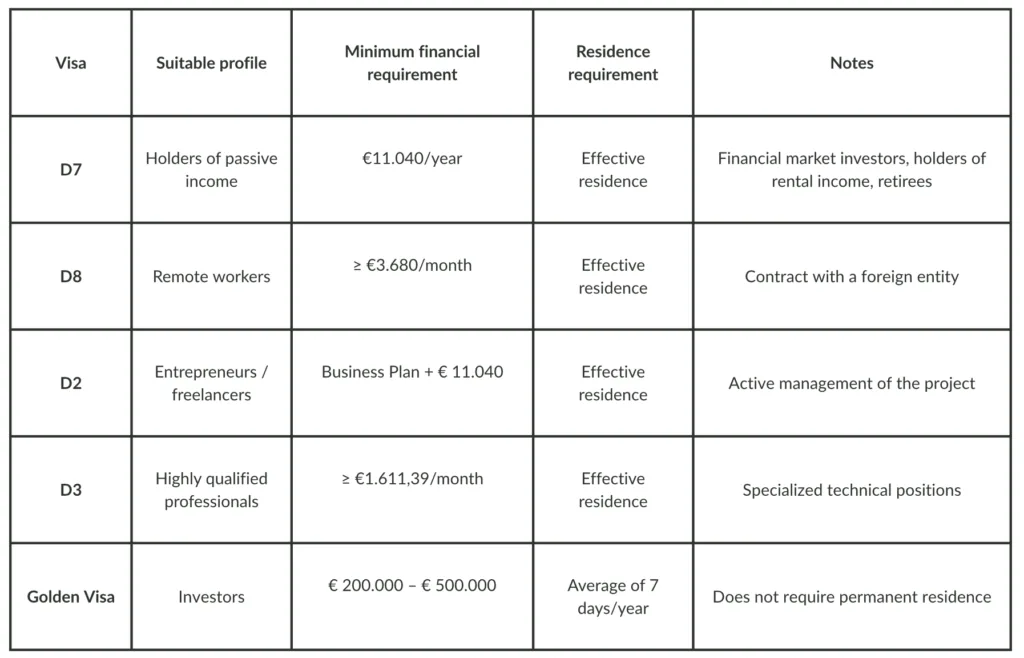
Main Residence Visas in Portugal – Comparative Overview
D7 Visa – Residence for Holders of Passive Income
The D7 Visa is intended for foreign nationals who have their own stable and sufficient income to support themselves in Portugal. Eligible income includes, among others, pensions, rental income, dividends, or other financial investments. In 2026, the minimum reference amount required is €11,040 per year, corresponding to twelve national minimum wages. It should be noted that merely meeting this amount is not sufficient. The authorities also assess the regularity of the income, its lawful origin, and the applicant’s genuine intention to reside in Portugal.
This visa is particularly suitable for retirees, asset holders, or financial investors who wish to establish stable residence in the country.
D8 Visa – Residence for Remote Workers
The D8 Visa, commonly known as the Digital Nomad Visa, is intended for professionals who carry out their work remotely for entities based outside Portugal. Applicants must have an employment contract or service agreement with a foreign entity and prove a minimum monthly income equivalent to four times the national minimum wage, i.e., €3,680 per month in 2026. This visa has become especially popular among professionals in the technology, creative, and consulting sectors, allowing them to reside legally in Portugal without terminating their international employment relationship.
Like the D7 Visa, the D8 requires effective residence in Portuguese territory.
D2 Visa – Entrepreneurs and Self-Employed Professionals
The D2 Visa is intended for foreign nationals who wish to carry out entrepreneurial or self-employed professional activities in Portugal. Its approval depends on the submission of a viable business plan, proof of adequate financial means, and coherence between the applicant’s profile and the proposed project. In 2026, the minimum reference amount for means of subsistence is €11,040 per year.
This visa is frequently used by entrepreneurs, freelancers, start-up founders, and liberal professionals who intend to engage in economic activity in Portugal on an active and ongoing basis.
D3 Visa – Highly Qualified Professionals
The D3 Visa is intended for professionals with high technical or academic qualifications who are hired by Portuguese employers. Legally, it requires the existence of an employment contract for a highly qualified position, appropriate qualifications for the role, and a minimum salary equivalent to three times the Social Support Index (IAS), which corresponds in 2026 to €1,611.39 per month.
As with the previous visas, this visa also requires effective residence in Portuguese territory.
Golden Visa – Residence Permit for Investment
The Golden Visa remains an attractive option for investors seeking residence in Portugal without the obligation of permanent residence in the country.
Currently eligible investment routes include, among others:
a minimum investment of €500,000 in Portuguese investment funds;
a donation between €200,000 and €250,000 to approved cultural projects.
One of the main advantages of this regime is the reduced physical presence requirement in Portuguese territory, set at an average of 7 days per year.
The Importance of an Informed Choice
Choosing a residence visa should not be done automatically or based solely on financial criteria since each visa corresponds to a different life project and entails distinct legal, tax, and personal obligations. An inappropriate choice may result in refusals, significant delays, or the need to restart the entire immigration process. The correct choice of visa and proper preparation of the application are decisive factors for a successful outcome.
For a personalized analysis of your situation, it is advisable to seek specialized legal assistance from a qualified lawyer licensed to practice in Portugal.
João Rebelo Maltez | Senior Lawyer at RME Legal
Ariana Monteiro | Trainee Lawyer at RME legal
Disclaimer
This article is not legal advice and does not replace consultation with a qualified professional. Each case depends on its own specific facts, documents, and eligibility conditions. Families should always seek authorized legal guidance to confirm that all legal requirements are met before submitting any application.
Get personalized legal advice for your situation from RME Legal.